(Last updated: April 3, 2026.) This post is available for discussion on Reddit.
How Do I Get an Actual Hot Wash Out of my LG Front Loader (LGFL)?
I recently decided to map out exactly what wash temperatures I was seeing in my LGFL washers. After an initial look it became clear that these LGFL machines behave very differently with temperature than what I had previously assumed and than what is written in most official documents I’ve found. It’s also telling that the official US manuals for the machines don’t list ANY temperatures and only say that the internal heater is used for the “extra hot” setting. As best I can tell, these behaviors seem specific to the US versions of the machines and the culprit is the US Department of Energy (DOE) energy consumption standards which require the machine makers to implement automatic temperature control and which specify hot as 100F (38C) - 108F (42C). Apparently the days of “hot means 140F (60C)” are long gone in the US. It’s also no longer true that hot means “the hot water temp at your tap” anymore. So what temperatures are you actually getting?
How I Tested#
I initially started out with a thermometer checking the temp a few times during the cycle, but I was quickly thwarted when the machine got hot enough to decide to lock the door. I then briefly considered measuring the exit temperature of the water, but that wouldn’t work for the sanitary cycle because that cycle ends by flooding cold water into the wash water before draining as a protective measure. After some research I learned that there is such a thing as an industrial temperature logger for washing applications - a measuring device you stick directly into your washing machine. For these tests I used a Lascar EL USB Pro, tied into a sock and stuffed into a small mesh bag. It performed admirably in case you want to do your own experiments at home.
Note that most of the LGFL machines have a button combination that lets you read the exact temp of the thermistor at that moment. Sadly I could not find this feature on my WM5800 which has the new touch interface instead of traditional buttons. Your machine may have this capability, but know that the temperature at the thermistor will be a couple degrees higher than the temp in the drum because of thermal loss to the machine during operation.
All my tests were conducted with a US LGFL WM5800. My hot water at the temp is a consistent 115-117, with a recirculating system and a tankless hot water heater. My test load was always 5kg of white towels, which is the largest load I run in these machines. I looked at the following cycles: Towels, Sanitary, and Allergiene.
Hot Is the New Warm#
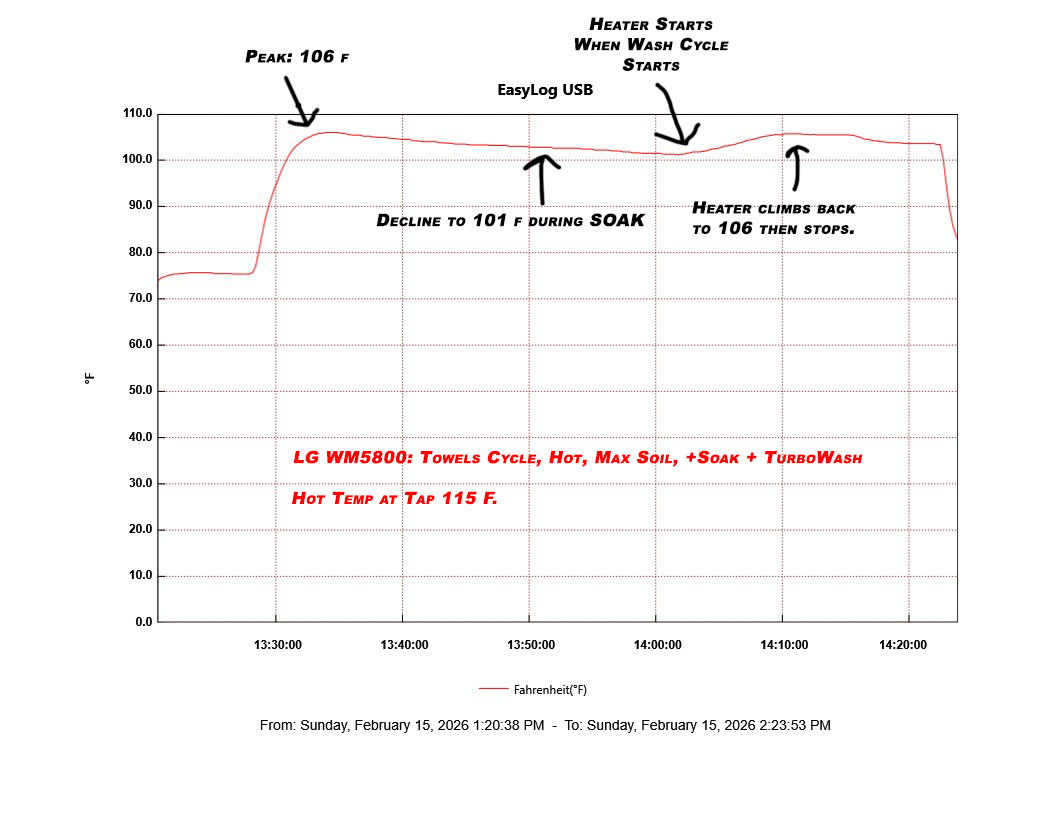
For the Towels cycle, my cycle settings were: Towels, Hot Water, Max Soil, +Soak Modifier, +TurboWash Modifier. Here’s the temp graph:
Observations:
- Right out of the gate the machine nerfs the temp to 106 degrees.
- There is no internal heating during the 30 minute soak and roll period so the temp declines gradually to 101.
- The internal heater does kick on during wash cycle, but stops heating a the target 106.
- Soak plus wash cycle time is 55 minutes, which is reasonable for this temp. The wash cycle time with the soak would be a little short IMO..
- Water levels were good and needed no adjustment.
My Thoughts:
- These temps are just over the phase transition range for human sebum, and they are in the goldilocks zone for enzyme activity, so this is likely an effective cycle for cleaning - but a solid dose of enzymes including lipase and extending the cycle time with 30 minutes of soak is crucial.
- At temps below 86F the sebum will remain solid, and the enzymatic activity will be hampered, so I would expect cleaning performance to drop noticeably if the water setting was reduced to warm and/or if the cycle time was reduced to the normal ~20 minutes you get without adding the soak period(s).
- This cycle will only partially activate sodium percarbonate unless you use a detergent with TAED. At any temp setting below hot and/or without the extended cycle time from soaking, the value of sodium percarbonate without TAED in the load is questionable at best.
Sanitary Not So Scary#
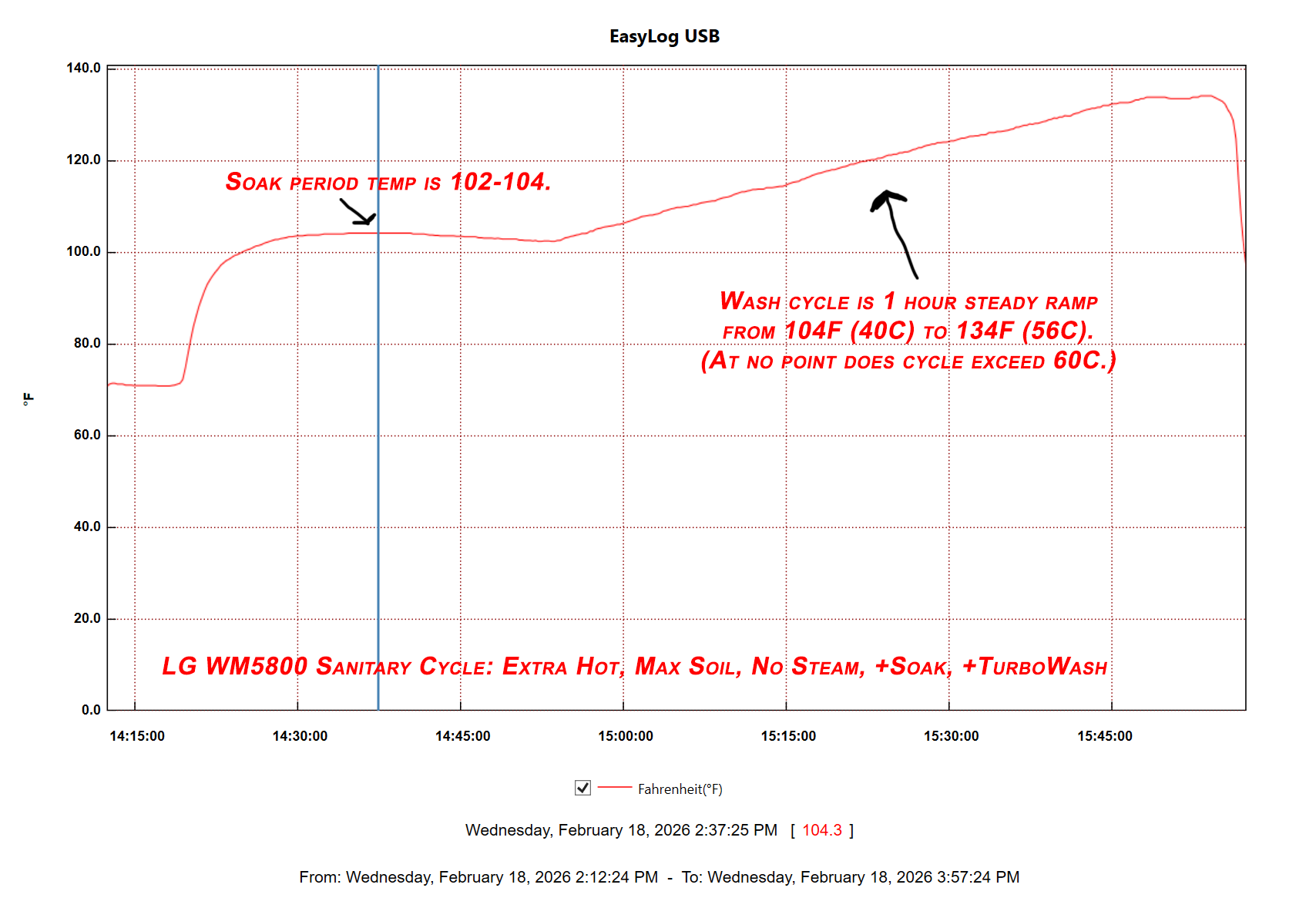
The official documentation I can find online for LG machines says that the sanitary cycle heats to 158F (70C) which is way too hot to be used casually on your laundry. The machine also locks the door during the sanitary cycle making it hard to check. So, what really goes on inside these machines when you select “sanitary”? Good news: it’s not that scary.
Observations:
- Right out of the gate the machine nerfs the temp to ~106F degrees again… even with the extra hot setting enabled.
- There is no internal heating during the 30 minute soak and roll period so the temp declines gradually to ~102F.
- The internal heater does kick on during wash cycle and it ramps gradually from 104F (40C) to 134F (56C).
- Time above 50C is about 25 minutes, and at no point does the temp exceed 60C.
- Soak plus wash cycle time is 90 minutes, which is downright luxurious.
- Water levels were good and needed no adjustment.
My Thoughts:
- This doesn’t look anything like a scary sanitary cycle… it looks like a pretty standard European hot 60C cycle.
- The temperature ramp over the cycle is great because it doesn’t denature the enzymes until late in the cycle, allowing for good enzymatic cleaning.
- This cycle will properly activate sodium percarbonate without TAED.
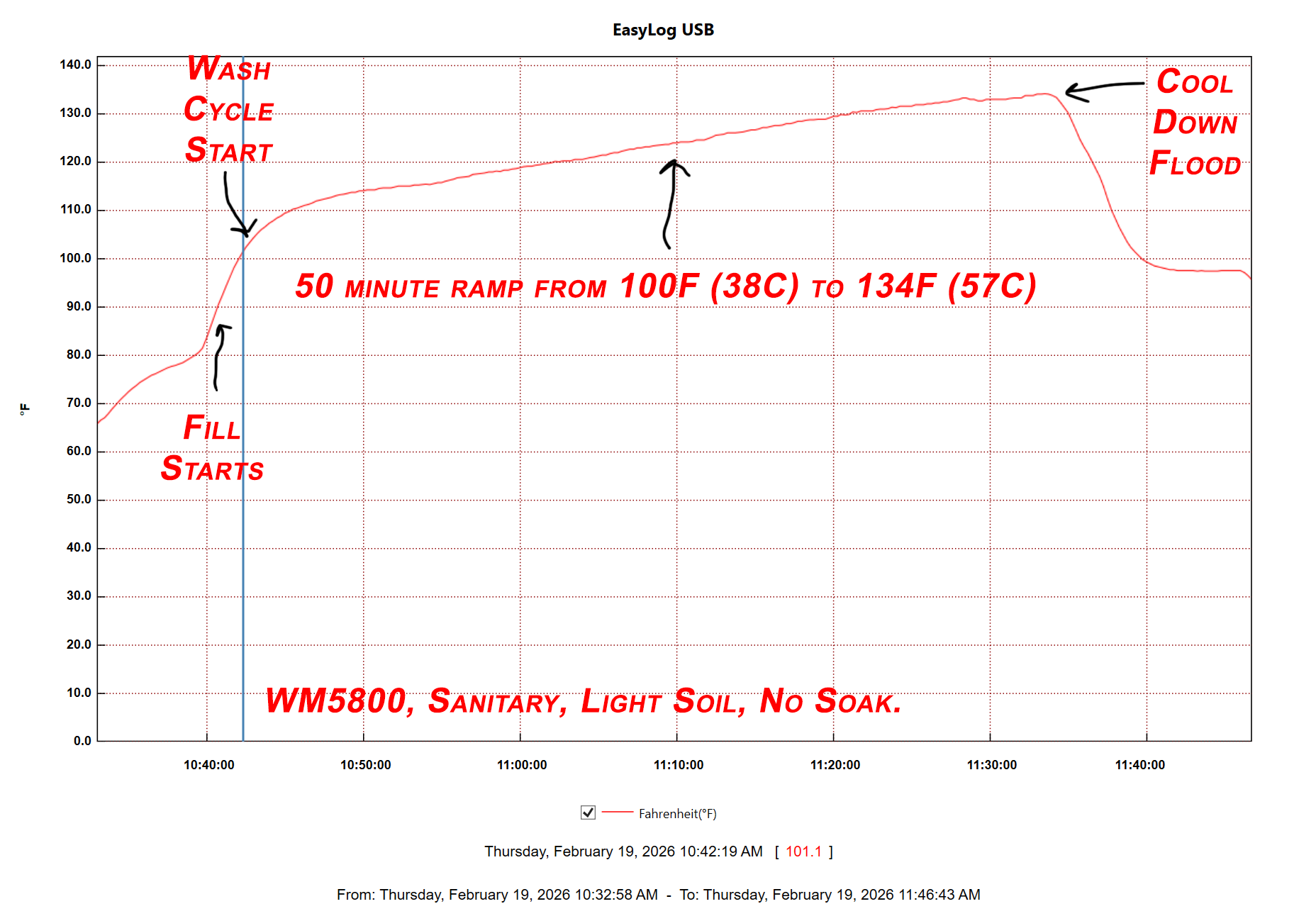
With soaking, the wash cycle time was 90 minutes which is more than needed at these temps for all but the most intensive cleaning so I decided to run the test again with the shortest cycle possible. Here’s what it looked like:
My Thoughts:
- This cycle looks good for a proper hot water wash. Solid cycle time, nice temp ramp, responsible water management.
- If you boost the wash water level manually by 2L - 4L, this starts to look pretty similar to an Asko 60C cycle.
Allergiene Is Poor#
The manual says this about the Allergiene cycle: “This is a powerful, high-temperature cycle designed specifically to reduce non-living allergens.” That sounds promising, yes? Well I have some bad news for you: this cycle is not good at cleaning IMO.
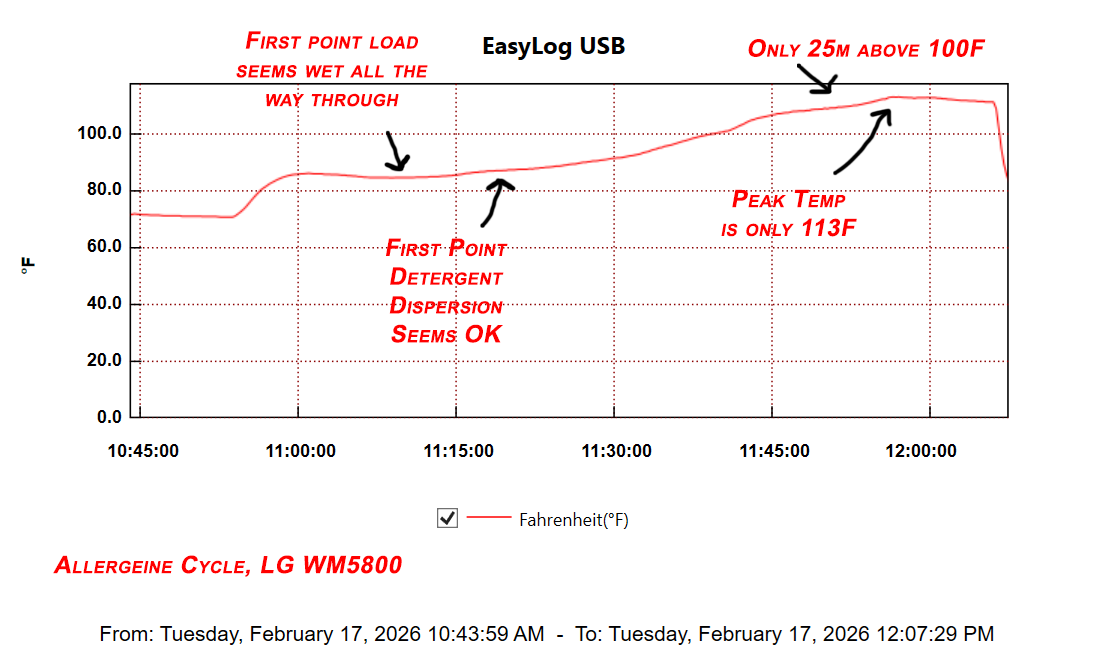
The only modifier available on the Allergiene cycle is TurboWash. The other modifiers are disabled because this is a steam cycle. Since steam is used in the wash cycle the TurboWash feature does NOT engage during the wash cycle - only the rinse cycle. This means the machine does a slow, methodical low water fill which means wetting and detergent dispersion take up the first 30 minutes of the wash cycle. Also, the machine undershot the mark on water level and I had to boost it with 2L of water to get detergent dispersion to happen at all. The cycle would have mostly failed to clean without this intervention. Also the water temp is nerfed to 86F / 30C. Here’s the play-by-play:
Cycle Log:
- 0:00 Initial wetting is by short periodic water bursts with tumbling.
- 0:15 Some of the load is still not wetted through. Temp is nerfed to ~86F / 30C.
- 0:25 Load seems wetted through but detergent dispersion is poor because of low water level. Filling has stopped.
- 0:26 Load is not drippy, no evidence of detergent dispersion. Water level is too low for cleaning. Boosting with 2L tap hot water at 117F.
- 0:33 First evidence of trace suds so detergent dispersion is starting to happen.
- 0:37 Wash tumbling is ongoing. Water level still feels slightly low - I’m not seeing any active edge drips… but I’m going to leave it. I’m guessing the low water level is necessary to maximize the impact of steam? Temp reading is only 88F.
- 0:37 - 0:57 Temp rises gradually from 88F / 31C to 104F / 40C.
- 0:62 Machine added small amount of water. Temp is 107F / 42C.
- 0:67 Machine added more water. Seeing edge drips now - my minimum baseline for a low water wash. Temp is 109F / 43C.
- 0:70 Peak temp 113F / 45C.
- 0:72 Wash cycle ends and machine starts to drain for rinse.
- Rinse water levels seem fine.
Observations:
- The first 30 minutes of the cycle were not involved in cleaning in any meaningful way. The effective wash cycle time was about 45 minutes.
- The total time above 104F / 40C was less than 25 minutes. The peak temp was 113F / 45C.
This is a pretty worthless cycle for cleaning IMO. The initial 30 minutes spent slowly wetting the textiles feels like time wasted. The insufficient fill level further hampers wash performance and the cycle wouldn’t have done almost any cleaning without the water boost I provided at the 25 minute mark. (If you want to know more about managing water levels in LGFL machines, see my other post here: http://redd.it/1pijvae.)
Assuming the value of this cycle is in the application of steam (which I am pretty suspicious of and don’t know how to quantify), the only way I could maybe imagine using it would be to properly clean the load with the towels cycle outlined above first without any extra rinses, and then following that cycle immediately with this cycle with no detergent to apply steam to the already clean load and complete the rinsing of the textiles. Honestly it feels like grasping at straws and I can’t imagine I’ll ever use this cycle, or any of the other steam cycles on the machine.
Beware Pre-Wash#
While pre-wash may sound like a potential way to extend your cycle time or improve cleaning you have to factor in that pre-wash is done with cold water. In the towels cycle I describe above, the entire 1 hour cycle time is above 38C / 101F. When I run the same towels cycle test above but with pre-wash enabled, the total time above 38C / 101F drops to about 18 minutes. This is a material penalty to wash temperature and will affect cleaning performance… probably more than the value of the pre-wash in all but the most extreme cases.
Conclusions#
The good news is that the LGFL machines with an internal heater can approximate a European 60C hot wash if you coax it out of them. The bad news is that your LGFL mostly lies to you about temperature, and for washing basic cotton laundry you probably want to make sure you’re at least using the “hot” water setting and using a detergent with a generous dose of enzymes. You should also do what you can to extend that wash cycle time. In fact, at these temperatures and with the short cycle default times, it seems worthwhile to make sure your enzyme doses are on the high side. Also, FYI, if you’re using a temperature setting below hot, you probably aren’t getting much oxidizing value from any sodium percarbonate you’re adding.
If you’re going to buy an LGFL getting one with an internal heater is mandatory IMO, and I highly recommend the WM5800 specifically because it’s the only LGFL machine with the SOAK cycle modifier. It’s really worth having this soak feature to extend wash cycle times given the temperature limitations. Over time I imagine LG will add the soak feature to the other machines in the lineup.